SUN-2C thematic school
This thematic school builds on the EUR SOLAR ACADEMY (USMB, CNRS, CEA – PIA-EUR program ANR-18-EURE-0016 – Solar Academy), which was created to address this global challenge of deploying solar potential through concrete integration solutions from buildings to cities. The SUN-2C thematic school will play an important structuring role in the research activities conducted within this pillar and will contribute to the visibility of the research units involved and, more broadly, of Université Savoie Mont Blanc.
SUN-2C aims to participate both in the dissemination of knowledge and the state of the art, but also in the popularization of advances in the following themes:
- Development of materials, components and systems for collecting and converting solar energy (Photovoltaic, Solar Thermal, etc.)
- Innovative technologies for the integration of solar energy in different environments: water area (floating), mountain (high altitude), farming (AgriPV), city (BIPV), …
- Analysis and design of integrated solar buildings in cities (solar urban development)
All these themes will be addressed in the form of educational and accessible presentations to all up to more advanced presentations, through lectures. Workshops and applied course will be spread over the week, encompassing the different scales covered and the associated scientific themes, to allow the participants to apply their knowledge to specific case studies.
Flyer SUN-2C thematic school (Nov2026)
→ Methods, outcomes and preliminary program
INTENSIVE WEEK at Saint Gervais from 2nd to 6th of November 2026
This includes:
- Arrival on the 2nd of November to Saint Gervais morning
- 2nd – 6th : week at Saint Gervais, shared with international scientists – accommodation, meals provided by organizers – courses, applied lectures and workshop
- 6th travel back
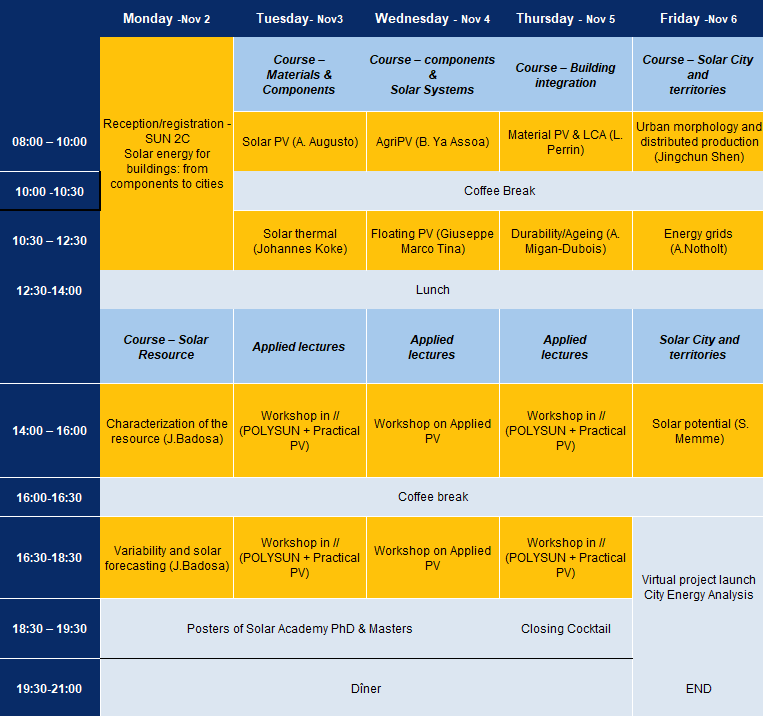
The on-site courses offered during the BIP in Saint-Gervais focus on solar energy and its integration into the built environment. The program covers key topics such as solar resource assessment, energy materials, system durability, and solar technologies including thermal systems, floating PV, and AgriPV.
Participants will also explore building integration (BIPV), life cycle assessment (LCA), solar potential at the urban scale, and energy grids. Theoretical sessions are complemented by practical workshops, allowing students to apply concepts in real-world contexts.
The program concludes with perspectives on solar cities, urban morphology, and distributed energy production, preparing students for the collaborative project using the City Energy Analyst tool.
The school will take place over five consecutive days in November 2026, according to the temporary program, you can find below:
→ For more information, you can download the SUN2C Speaker Presentation Booklet Final
VIRTUAL COMPONENT from 9th to 14th of November 2026
This includes:
- Presentation of City Energy Analyst (CEA) tool and training (starting during intensive week).
- Case study done by each group of participants (4 to 5 participants per group)
- On line final presentation of the projects
This activity aims to introduce students to urban energy modeling using the City Energy Analyst (CEA) tool, with a particular focus on integrating renewable energies, especially solar energy. Students who already have some experience with this tool thanks to the intensive week will work in groups on a study of a city or neighborhood of their choice.
In this context, they will analyze the energy performance of the area studied, notably by evaluating the solar potential of buildings (roofs, facades) and exploring different scenarios for integrating photovoltaic and thermal solutions. The objective is to propose concrete strategies to improve energy efficiency and increase the share of renewable energies in the urban energy mix.
At the end of the activity, each group will present its project in a videoconference presentation to a jury.
→ Venue
The SUN-2C thematic school will be organized as a residential event, bringing together experts and participants from various fields at a seminar venue for lectures and collaborative workshops.
→ Target Audience
This thematic school will be organized as a Blended Intensive Programme (BIP) and is open to CNRS and academic staff, including PhD candidates and postdoctoral researchers, interested in the targeted themes. The school will also be open to Master’s students, including those enrolled in the Master’s program “Energy and Solar Buildings and Cities” (ESBC) led by the EUR Solar Academy.
A significant portion of the school will be conducted in English to facilitate the participation of young international researchers and to promote the national scientific dynamic on this topic.
Participation of 40 people is expected.
____________________________________________________________________________________________________________________________________________________________________
Ecole thématique SUN-2C
Cette école thématique s’appuie sur l’EUR SOLAR ACADEMY (USMB, CNRS, CEA – programme PIA-EUR ANR-18-EURE-0016 – Solar Academy), créée pour relever ce défi mondial que représente la mise en œuvre du potentiel solaire grâce à des solutions d’intégration concrètes, allant des bâtiments aux villes. L’école thématique SUN-2C jouera un rôle structurant important dans les activités de recherche menées au sein de ce pilier et contribuera à la visibilité des unités de recherche impliquées et, plus largement, de l’Université Savoie Mont Blanc.
SUN-2C vise à participer à la fois à la diffusion des connaissances et de l’état de l’art, mais aussi à la vulgarisation des avancées dans les thèmes suivants :
- Développement de matériaux, de composants et de systèmes pour le captage et la conversion de l’énergie solaire (photovoltaïque, solaire thermique, etc.)
- Technologies innovantes pour l’intégration de l’énergie solaire dans différents environnements : milieu aquatique (flottant), montagne (haute altitude), agriculture (AgriPV), ville (BIPV), …
- Analyse et conception de bâtiments solaires intégrés en milieu urbain (développement urbain solaire)
Tous ces thèmes seront abordés sous la forme de présentations pédagogiques et accessibles à tous, mais aussi de présentations plus avancées, dans le cadre de conférences. Des ateliers et des cours pratiques seront organisés tout au long de la semaine, couvrant les différentes échelles abordées et les thèmes scientifiques associés, afin de permettre aux participants d’appliquer leurs connaissances à des études de cas spécifiques.
Flyer école thématique SUN-2C (Nov2026)
→ Méthodes, résultats et programme préliminaire
SEMAINE INTENSIVE à Saint-Gervais du 2 au 6 novembre 2026
Au programme :
- Arrivée le 2 novembre au matin à Saint-Gervais
- Du 2 au 6 novembre : semaine à Saint-Gervais, en compagnie de scientifiques internationaux – hébergement et repas pris en charge par les organisateurs – cours, conférences pratiques et ateliers
- 6 novembre : trajet retour
Les cours dispensés sur place dans le cadre du BIP à Saint-Gervais sont axés sur l’énergie solaire et son intégration dans l’environnement bâti. Le programme aborde des thèmes clés tels que l’évaluation des ressources solaires, les matériaux énergétiques, la durabilité des systèmes et les technologies solaires, notamment les systèmes thermiques, le photovoltaïque flottant et l’AgriPV.
Les participants exploreront également l’intégration dans le bâti (BIPV), l’analyse du cycle de vie (ACV), le potentiel solaire à l’échelle urbaine et les réseaux énergétiques. Les sessions théoriques sont complétées par des ateliers pratiques, permettant aux étudiants d’appliquer les concepts dans des contextes concrets.
Le programme se termine par une réflexion sur les villes solaires, la morphologie urbaine et la production d’énergie décentralisée, préparant ainsi les étudiants au projet collaboratif utilisant l’outil City Energy Analyst.
La formation se déroulera sur cinq jours consécutifs en novembre 2026, selon le programme provisoire que vous trouverez ci-dessous
→ Pour plus d’information, vous pouvez télécharger le SUN2C Speaker Presentation Booklet Final
MODULE VIRTUEL du 9 au 14 novembre 2026
Ce module comprend :
- Présentation de l’outil City Energy Analyst (CEA) et formation (dès le début de la semaine intensive).
- Étude de cas réalisée par chaque groupe de participants (4 à 5 participants par groupe)
- Présentation finale en ligne des projets
Cette activité vise à initier les étudiants à la modélisation énergétique urbaine à l’aide de l’outil City Energy Analyst (CEA), en mettant particulièrement l’accent sur l’intégration des énergies renouvelables, notamment l’énergie solaire. Les étudiants qui ont déjà acquis une certaine expérience de cet outil grâce à la semaine intensive travailleront en groupes sur l’étude d’une ville ou d’un quartier de leur choix.
Dans ce cadre, ils analyseront la performance énergétique de la zone étudiée, notamment en évaluant le potentiel solaire des bâtiments (toitures, façades) et en explorant différents scénarios d’intégration de solutions photovoltaïques et thermiques. L’objectif est de proposer des stratégies concrètes pour améliorer l’efficacité énergétique et accroître la part des énergies renouvelables dans le mix énergétique urbain.
À l’issue de l’activité, chaque groupe présentera son projet lors d’une visioconférence devant un jury.
→ Lieu
L’école thématique SUN-2C sera organisée sous la forme d’un événement résidentiel, réunissant des experts et des participants issus de divers domaines dans un lieu dédié aux séminaires pour des conférences et des ateliers collaboratifs.
Plus d’informations sur le lieu
→ Public cible
Cette école thématique sera organisée sous la forme d’un programme intensif mixte (BIP) et s’adresse au personnel du CNRS et des universités, y compris les doctorants et les chercheurs postdoctoraux, intéressés par les thèmes abordés. Elle sera également ouverte aux étudiants en master, notamment ceux inscrits au master « Énergie, bâtiments et villes solaires » (ESBC) dirigé par l’EUR Solar Academy.
Une grande partie de l’école se déroulera en anglais afin de faciliter la participation de jeunes chercheurs internationaux et de promouvoir la dynamique scientifique nationale sur ce sujet.
La participation de 40 personnes est prévue.