
→ TRAINING BY RESEARCH
A 56% increase in world energy demand is expected from 2010 to 2040. Solar energy technologies may play a significant role in the energy transition, through passive applications and power generation, whilst helping to tackle issues of the climate change, population increase, energy security, water scarcity, economic growth and rising urbanization. The solar resource is abundant and diffuse, and hence particularly well suited to the building sector. Moreover, it can be a vector for growth, linking economic objectives to the emergence of future technologies. The challenge is to transform this potential into real power generation.
Solar Academy Graduate School is located on the INES campus in Savoie, France. INES (National Institute for Solar Energy) is a platform for research in Solar Energy (100 M€ invested in 10 years) with 450 employees working at INES in 2019 (about 350 at CEA and 100 at USMB/CNRS).
The Solar Academy combines practice and theory in the areas of solar and building physics, scientific computing, material science, business, law, sociology architecture and urban planning.
The mission of the Solar Academy is to become a national and international leader in scientific research, engineering, business, economy and law for a model of low-carbon distributed generation and consumption. Central to its organization is a multidisciplinary approach to enable the large-scale utilization of the solar energy resource.
Pr. Monika Woloszyn, director of the Solar Academy assisted by Pr. Christophe Ménézo as Deputy Director for national and international partnerships and Pr. Dorothée Charlier as Deputy Director.
→ MANAGEMENT OF THE SOLAR ACADEMY
Pr. Monika Woloszyn 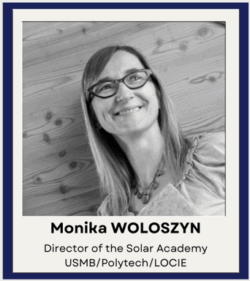 is full professor at Université Savoie Mont Blanc since 2011 and Director of the LOCIE research unit. Her research focuses on heat and mass transfer in building envelopes, solar buildings, environmental performance, and occupant impact. She has co-authored over 50 international journal articles and around 100 international conference papers, serves as associate editor of Building and Environment, and is a member of several scientific committees.
She has received multiple awards, including the French Scientific Excellence Bonus, and has been actively involved in research evaluation bodies. Monika Woloszyn also participated in ANR evaluation committee and acted as a member of Comeval (Multidisciplinary Advisory board for recruitment and career assessment for researchers of French Ministry of Ecology Transition). She has also played a major role in research projects and higher education, co-supervising many PhD students. Contact
Pr.Christophe Ménézo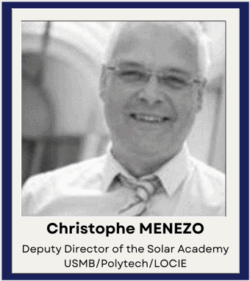 is Director of the CNRS Research Federation on Solar Energy (FédESol) and leads the green/smart building group within the French–Singaporean SINERGIE network. His research focuses on solar energy integration in buildings, advanced building envelopes, and solar potential at city scale. He has authored nearly 50 international journal papers, several book chapters, and a book on bio-inspired engineering. He has received multiple international distinctions and has held key academic, industrial, and innovation leadership roles, including the creation of a solar systems research team and the co-founding of a startup project.
His current research is led at the INES, LOCIE lab and focuses on building integration of solar components (especially on photovoltaic and hybrid PV/Th solar components), redefinition of building envelopes conventionally concerned with insulation and sealing in order to include dynamic and active features (energy collect and conversion, ventilated solar envelope) and more recently on solar energy potential at city scale (solar cadastre) especially on Great Geneva (as French leader of the Interreg G2 Solaire project). Contact
Pr. Dorothée Charlier 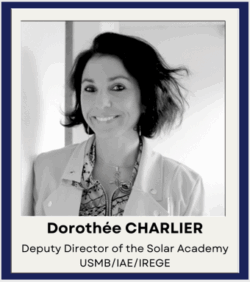 is a professor of Energy and Environmental Economics. Her research examines household energy consumption, energy efficiency, energy poverty, and the evaluation of public policies aimed at reducing emissions and improving living conditions. She studies how socio-economic factors, behaviours, and contextual constraints shape energy use and policy effectiveness, with recent work focusing on climate adaptation and responses to extreme heat. Her methodology combines econometrics, behavioural analysis, and causal inference to support the design of effective and socially equitable public policies.
Over the past fifteen years, she has studied the determinants of energy-saving investments, the drivers of energy demand, and the multiple dimensions of energy poverty in both high-income and developing country contexts. She uses quantitative causal inference and mixed empirical strategies to identify mechanisms, heterogeneity, and socially meaningful policy levers. Contact