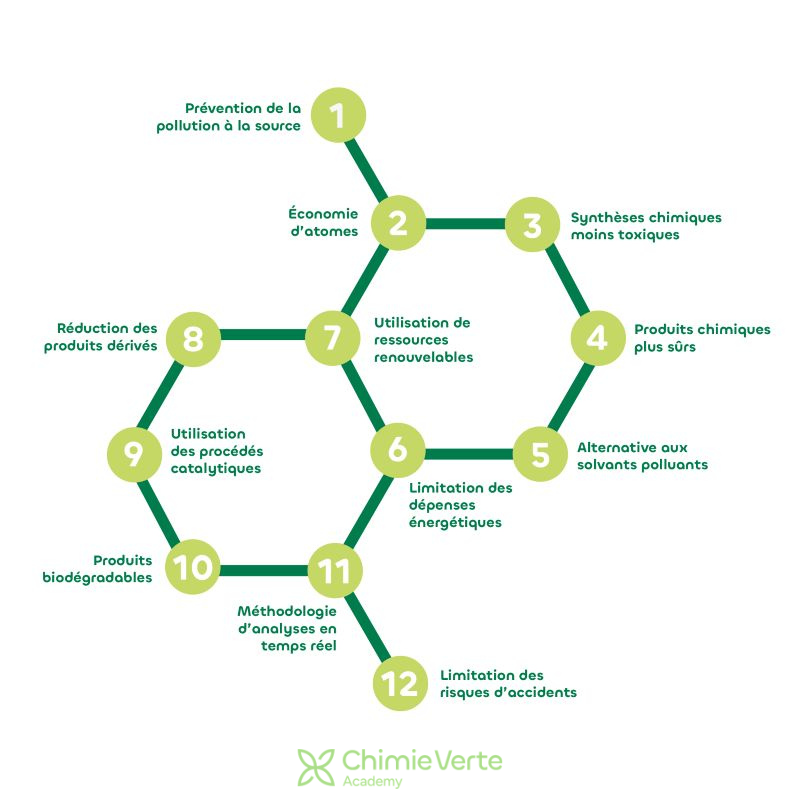
It is better to design a process that does not produce waste or toxic byproducts from the outset, rather than having to treat or clean up toxic residues afterward.
This is the fundamental principle of green chemistry.
The synthesis should be designed to maximize
the incorporation of all the atoms from the reactants into the final product.
The fewer atoms that are "lost" as byproducts, the more efficient and sustainable the process is.
Whenever possible, synthetic methods should use and produce
substances that are low in toxicity or non-toxic to humans and the environment.
Final chemical products must be designed to
fulfill their intended purpose while being as non-toxic as possible.
The product’s effectiveness must not come at the expense of health and environmental safety.
The use of solvents, release agents, and other auxiliary substances
should be avoided as much as possible or replaced with less hazardous alternatives,
such as water or bio-based solvents.
The energy requirements of chemical processes must be minimized
to reduce their environmental and economic impact.
Ideally, syntheses should be carried out at ambient temperature and pressure.
A particular raw material or resource should be prioritized
if it is renewable (such as plant biomass),
rather than a fossil fuel and a finite resource (like oil).
Unnecessary synthesis steps (such as the use of
(protective groups) should be minimized or avoided
to reduce reagent consumption and waste generation.
Catalytic reagents (used in small quantities and
(recyclable) are preferable to conventional reagents
to speed up reactions and improve their selectivity.
Chemicals must be designed in such a way that
that at the end of their life cycle, they break down into non-toxic substances and
do not persist in the environment.
Analytical methods must be developed to
enable real-time monitoring and control of the process,
in order to prevent the formation of hazardous substances.
The selection and physical condition of the substances used in a
The risks associated with the process must be minimized
chemical accidents, such as explosions, fires, and toxic releases.