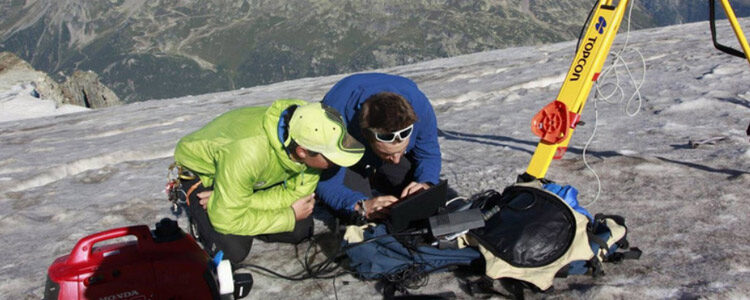
We offer a wide range of recognized training courses in Earth Sciences at Bachelor's and Master's level. The strong point of our academics is hands-on practice in geology and geophysics, taking advantage of the extraordinary Alpine context around Chambéry. Our courses offer a wide and expanding range of career opportunities, with a focus on both research and applied geology.
Training in earth sciences
License
La Licence sciences de la terre prévoit 3 parcours possibles :
- le parcours Géosciences (L2, L3) est organisé pour une spécialisation progressive dans les différents domaines des Sciences de la Terre
- le parcours Environnement (L2, L3) est axé sur les problématiques autour de la gestion des milieux naturels et s’appuie sur davantage d’enseignements en biologie et chimie
- le parcours CMI (Cursus Master en Ingénierie) est un parcours Géosciences renforcé avec 20% de plus d’enseignements pour former aux métiers de l’ingénieur par la recherche
Nous avons également mis en place un semestre international qui s’appuie sur certains modules de L2 et L3 permettant à la fois la venue d’étudiants étrangers et la pratique de l’anglais disciplinaires pour nos étudiants. Consulter la fiche d’information en anglais.
D’autres informations sur la Page Facebook de la Licence Sciences de la Terre
Master
- the Master Georesources, Geohazards, Geotechnics is designed for students interested in geotechnics, one of the geosciences sectors with the best job prospects. At the start of the 2023 academic year, it will comprise two tracks:
- Geosciences Applied to Land Development Engineering (GAIA) course focusing on the study, modeling and land development engineering of surficial geological formations.
- Parcours ALEAS (nouveau parcours – ouverture 2023) orienté Recherche et Développement dans le domaine des aléas géologiques : aléas gravitaires (éboulements, glissements de terrain), aléas torrentiels, sismiques, volcaniques.
- le Master Gestion de l’environnement, qui comprend 3 parcours, est destiné aux étudiants qui souhaitent se spécialiser dans l’étude et la gestion des problématiques environnementales, notamment dans les milieux de montagne
Teaching team
academics in Earth Sciences at the USMB are organized by the Teaching Department, made up of 18 teacher-researchers from the ISTerre and Edytem laboratories.
Contact
- Directeur du Département : Yann Rolland (yann.rolland@univ-smb.fr)
- Responsable Licence : Pierre Sabatier (pierre.sabatier@univ-smb.fr)
- Responsable Master GAIA : Joseph Martinod (joseph.martinod@univ-smb.fr)
Professional integration
Geotechnics, hydrogeology, energy, environment, mineral resources, teaching and research
Associated laboratories
The Earth Sciences Department is supported by the ISTerre and Edytem research laboratories.
Testimonials
The versatility of the Master's program has enabled me to study different aspects of geology applied to the professional world: whether it's an opening towards research, the geotechnical field or the world of special works. The naturalist approach to academics, particularly in mountain environments, is a real asset when it comes to tackling construction site issues and proposing realistic solutions to geotechnical problems or those linked to natural hazards. The course is a real learning experience, with numerous case studies in the field. The more theoretical academics of structural design are also highly specialized, with differentiated courses. The icing on the cake is that the academics are located at Le Bourget du Lac, in an idyllic setting for mountain lovers, with many courses given in the field. Joining the GAIA Master's program also means joining a network of competent people, with real follow-up for former students.
I really enjoyed my time atUniversité Savoie Mont Blanc, where everything is geared towards student success! First of all, the scientific campus at Le Bourget du Lac is located in a unique natural setting: between the Lac du Bourget and the Alpine massifs, it's a great opportunity to study in this natural environment and at the same time just a stone's throw from major cities such as Lyon and Turin. The teaching environment is also pleasant, and I've been lucky enough to be in small classes in geology (20-25 students), so the teaching is more personalized and the teacher/student ratio is closer. This bachelor's degree is fortunate in that it is made up of a wide range of different courses, offering both a solid scientific foundation and an important background for continuing on to a Master's degree, whether research or professional. What's more, the Université Savoie Mont-Blanc benefits from numerous agreements with foreign universities, giving the opportunity for international mobility. In fact, I myself spent an ERASMUS year at the University of Iceland in Reykjavík.