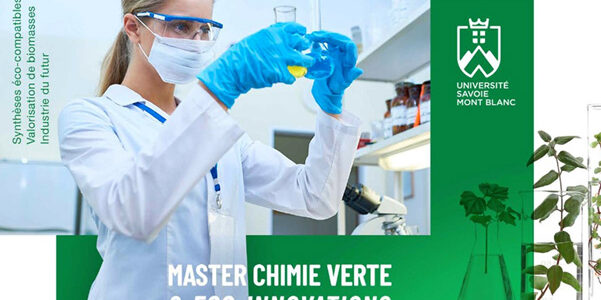
Master's degree in green chemistry and eco-innovations

Apply for the Master

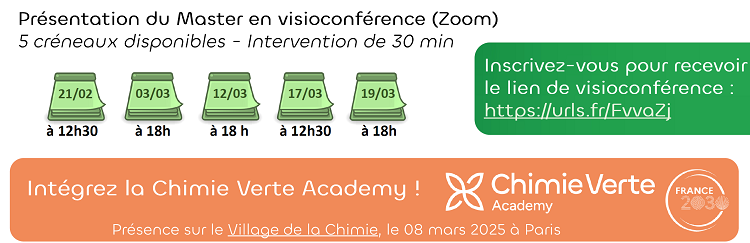
Opening of the Mon Master platform 

February 25 to March 24, 2025

As part of this Master's program, students are trained in greener, more sustainable chemistry, in a context of circular economy and bioeconomy, in line with current and future environmental issues. academics is therefore fully in line with the priorities of the France 2030 plan. academics focuses on the eco-compatible synthesis of molecules, materials and polymers, using innovative technologies and new analytical and digital tools for chemistry. A multi-disciplinary approach enables students to grasp the full range of issues involved in green chemistry, biomass and waste recovery, and process transformation. This Master's degree covers all chemical industries and their applications, including fine chemicals, agrifoods, pharmaceuticals, agriculture, cosmetics, nutraceuticals, paints, inks, glues, adhesives, perfumes, essential oils, cleaning products, fertilizers, food packaging, waste, biotechnologies, pollution control materials, aeronautics, automotive, plastics, etc.

The right academics

In classic initial academics
In sandwich academics
Continuing academics for certain teaching modules

academics is tailored to the student's career plans in industry or academic research.

The main aim of the teaching team is to train competent, committed, motivated and independent chemists for tomorrow's chemistry, and to help them enter the professional world or pursue a doctorate.

We are looking for chemistry and biochemistry students with a good level of undergraduate studies in organic chemistry, inorganic chemistry and analytical chemistry. A strong interest in green chemistry is a prerequisite for enrolment in academics. Recruitment is selective, based on an analysis of students' applications (academic results, motivation, career plans).

Targeted skills

  • Design, implement and evaluate green chemistry synthesis routes;
  • Enhancing the value of materials in the context of the environmental, socio-economic and regulatory challenges of sustainable development;
  • Take a scientific approach to solving complex problems;
  • Assess the economic, regulatory and/or environmental impact of an existing or future process;
  • Integrate and develop in a chosen professional environment ;
  • Carry out projects contributing to research, development and innovation

CAREER OPPORTUNITIES

  • Chemical engineer in R&D, production, technical sales or consulting
  • Design engineer/Research engineer
  • R&D laboratory research manager
  • R&D laboratory project manager/manager
  • Project Manager
  • Pursue a doctorate to become a researcher, teacher-researcher in the academic sector or senior R&D executive in industry.

The chemical industry is the first to be concerned, but many other sectors may need the students trained in the Green Chemistry and Eco-Innovations Master's degree to find new solutions in order to :

  1. develop and implement a cleaner, more energy-efficient process or product, limiting the use of hazardous or toxic products, limiting waste or by-products, using catalysts;
  2. Recover waste and residual biomass from processes and manufacturing;
  3. assess the economic, regulatory and environmental impact of an existing process.

Students and graduates will be able to contribute to France's bioeconomy strategy, to the implementation of the law on the fight against waste and the circular economy, to the national strategy for ecological transition towards sustainable development, and to the opportunities offered by theindustry of the future. This means that a wide range of applications can be directly involved. academics is also in line with the objectives of the France 2030 strategy.

The job objectives are linked to green chemistry and the chemical industry of the future:

  • Limit pollution at source rather than managing waste disposal (prevention).
  • Design chemical syntheses that are less harmful to man and the environment: limit the use of harmful substances, reduce the production and discharge of by-products, develop reaction conditions that respect the environment and health, reduce the use of organic solvents, etc.
  • Designing safer, more sustainable chemicals, materials and polymers.
  • Develop catalytic pathways (homogeneous, heterogeneous or enzymatic) for targeted chemical reactions.
  • Develop new technologies and processes to synthesize and prepare molecules, materials and polymers with low environmental impact.
  • Use renewable raw materials, co-products and waste.
  • Assess the environmental and economic impact of a new value chain.
  • Use mathematical and digital tools to develop cleaner, safer production processes.
  • Produce organic molecules of interest for various applications
  • Prepare materials for the decontamination of gaseous and liquid effluents
  • Set up new circular economy and bioeconomy channels, in particular through waste recovery.

YOU ARE A COMPANY

Companies, become privileged partners of the Green Chemistry and Eco-Innovations Master's program and call on our students!

  • Master 1: 2 to 4-month internship starting in late March
  • Master 2: 4 to 6-month internship starting mid-February

Internship proposals to be submitted between September and December.

During their internship, students are supervised by an industrial tutor within the company and monitored by a university tutor. An internship report provides a comprehensive written record within the company. The internship work is defended before a jury of experts at the University.

The advantages of hiring a student on work-study contracts :

  • Recruit a motivated, pre-selected employee in a Master's degree academics
  • Put a student through his or her paces before considering recruitment, while benefiting from the support of the University. At the end of their academics, the apprentice is trained in the codes and methods of the company, guaranteeing easy integration into your teams should you ever need to recruit them.
  • Benefit from new skills at a "win-win" cost, thanks to attractive financial incentives
  • Handle an increase in activity by entrusting assignments and projects to a work-study student
  • Renew the company's know-how with students trained in cutting-edge fields, in line with the latest advances in Research.
  • Invest sustainably and responsibly in the skills of tomorrow by strengthening your CSR commitments through the integration of new generations.

Alternation rhythm :

  • Master 1: 15 days at the University / 15 days at the company from September to March, then full-time at the company from April to September.
  • Master 2: 15 days at university / 15 days in a company from September to February, then full-time in a company from February to September.

Possibility of taking on a student for M1, M2 or both years, under a professionalization or apprenticeship contract.

Examples of internship and/or work-study projects :

  • Drawing up an inventory of a raw material from an industry that can be used as a new resource in a given area.
  • Bibliographic review of a reaction or synthesis
  • Brainstorming solutions for recovering unused waste or co-products
  • Identify ways of optimizing process preparation

Companies can propose questions, technical or technological problems, experimental optimization requirements, bibliographic reviews or even innovation needs in environmental areas. These projects constitute first-level studies to gather preliminary results on certain projects or subjects that companies sometimes don't have the time to invest in.

A group of students, supervised by a tutor on the University's premises, work on your topic and submit their findings or conclusions to you. These projects are carried out over the course of a semester, and may involve surveys, bibliographical research, experimentation, creativity sessions and so on.

PITON is a program created byUniversité Savoie Mont Blanc and its Foundation. It gives a company, organization or local authority the opportunity to develop an innovative project with the help of a multidisciplinary team of students. All business sectors and all company sizes are involved. A chemist can join the multi-disciplinary student team, along with a lawyer, mechanical engineer, marketing student or any other academics who fit in with the project's multi-disciplinary approach! The advantages of the system are :
  • Collaborative work in startup mode for 12 to 20 weeks to produce proofs of concept
  • Customized support from innovation experts
  • Training in creativity, project management and innovation
  • An internship integrated into the diplomas prepared by students

Find out more about PITON
  • Or by following the full Chemistry and Eco-Innovations Master's program atUniversité Savoie Mont Blanc ;
  •  Or by choosing certain themes: à la carte blocks of skills and/or capitalizing on lessons to obtain a diploma.

Contact us to acquire all or part of the diploma on the basis of professional experience via Validation des Acquis de l'Expérience (VAE).

Join the teaching team as a guest lecturer and contribute to the professionalization of our academics. You can also take part in conferences and workshops to help bring companies and universities closer together.
  • Suggest a site visit to our students
  • Support academics with a donation of equipment or sponsorship

 You can download the presentation brochure in pdf format

academics' advantages


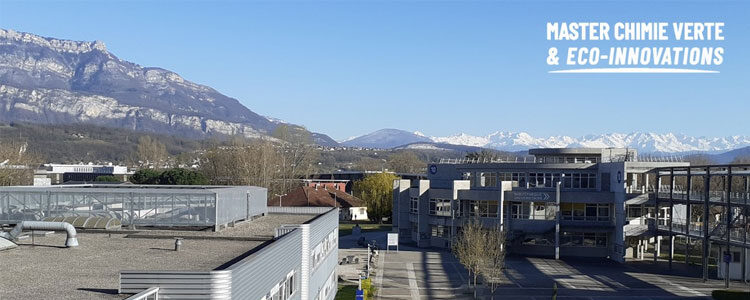
  • An exceptional place to study: nestled between lakes and mountains in the Savoie Mont Blanc region, the Le Bourget campus is located in a dynamic technology park with almost 5,000 students, 1,000 researchers and over 230 companies.
  • A high-quality science campus: university library, computer rooms, numerous student associations, sports and artistic activities, tutoring and support, research laboratories, etc.
  • Pathways adapted to all: disabled students are taken into account, as are sportsmen and women and top-level artists, who benefit from adapted timetables and examination procedures.
  • A high level of practical academics : internships, projects, group work and case studies, practical laboratory work, visits to companies and industrial facilities.
  • Option to follow a sandwich course, alternating between weeks of classes at the University and work in the company, for greater professional experience.
  • International scope: TOEIC® (Test of English for International Communication) exam organized every year, internships abroad, guest speakers in English.
  • A second-year specialization with a choice of two options: the valorization of organic molecules and applications, or the valorization of materials for pollution control.
  • The introduction of a skills assessment and individualized follow-up for each student over the two years of the Master's program.
  • Contributions by leading experts in the various fields taught, from laboratories in France and around the world.
  • A network of professionals who are directly involved in the Master's teaching modules, facilitating professional integration.

Acc'INNOV project wins AMI Emergences 2022 award

The Green Chemistry and Eco-Innovations Master's degree at the heart of the Acc'INNOV project:

In 2022, the Acc'INNOV project, led by the USMB Chemistry Department, won the "Emergences " call for expressions of interest launched by the MESRI (Ministry of Higher Education, Research and Innovation).

The Acc'INNOV project aims to develop, through the Green Chemistry and Eco-Innovation Master :

- innovative academics practices through a cross-disciplinary approach based on the emerging themes addressed in the Master's program (green chemistry, circular economy, decarbonized industry, biomass and waste recovery, technological eco-innovations),

- effective teaching methods and tools (personalized follow-up, active teaching, creation of professional networks, etc.).

The impact of the project concerns student success and the evolution of teaching practices within the Chemistry Department.

Particular attention will be paid to the transferability of the practices developed to other Master's courses in the UFR and the University.

In a more global context, the methodologies implemented could also be shared more widely with chemistry training courses at national level, by disseminating the results via the various partner networks and via MESRI.

Acc'INNOV, a project supported by AMI Emergences


Press and media review

Contact us

Master's management :

Contact: gregory.chatel@univ-smb.fr

Grégory CHATEL, Director of Studies
Laurence REINERT, co-director
Micheline DRAYE, co-director
Laurent DUCLAUX, co-director

Secretariat and pedagogical assistance :

Isabelle WAGNER: Secretariat.Chimie@univ-smb.fr (admissions, registration, timetable, budget and administrative procedures)

Séverine SANZ : severine.sanz@univ-smb.fr (company links, pedagogical follow-up, logistics).