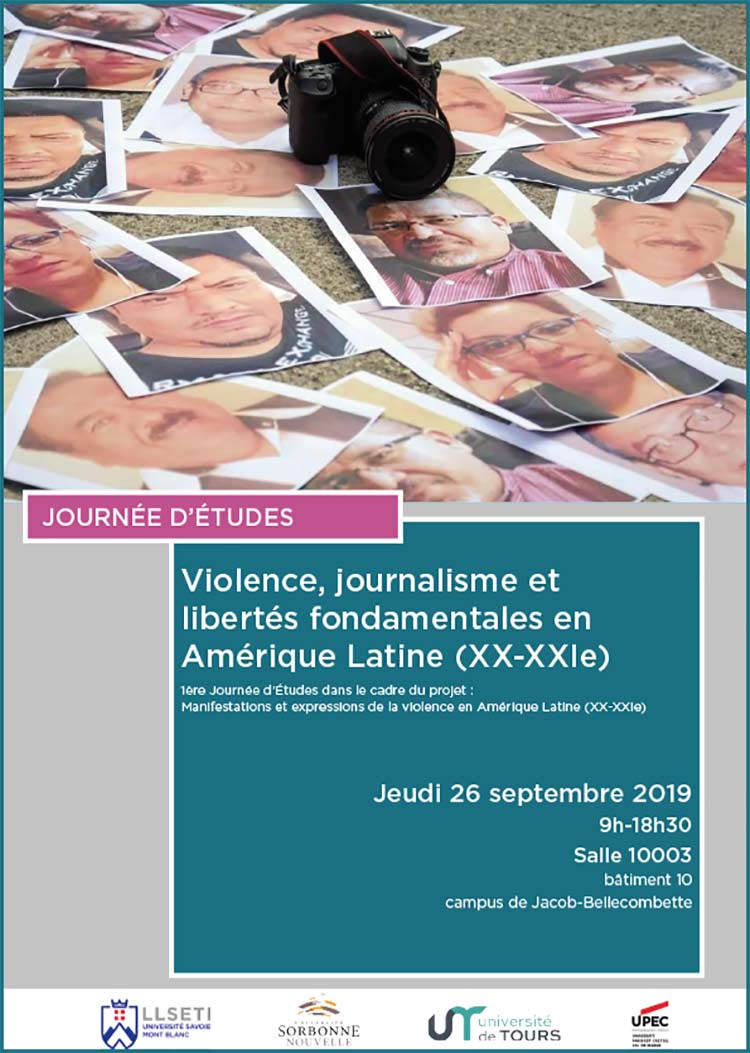
A seminar on the topic “Violence, Journalism, and Fundamental Freedoms in Latin America (20th–21st Centuries)” will be held on Thursday, September 26, 2019, from 9:00 a.m. to 6:30 p.m. in Room 10 003 in Building 10 on the Jacob-Bellecombette campus.
This seminar is part of the project “Manifestations and Expressions of Violence in Latin America (20th–21st Centuries).” The project is led by Sorbonne Nouvelle Paris 3, Avignon, Paris-Est Créteil, and Savoie Mont Blanc universities, in collaboration with the Langages, Littératures, Sociétés, Études Transfrontalières et Internationales research laboratory.
About the study day
In the Latin American context (20th and 21st centuries), the pervasive nature of violent acts—committed by authoritarian or dictatorial regimes as well as by various armed groups and criminal organizations—has raised numerous questions regarding public safety and respect for fundamental freedoms. Among these is freedom of opinion and expression, which is also one of the essential rights for the proper functioning of society and is enshrined in Article 19 of the Universal Declaration of Human Rights. It should be emphasized that freedom of expression is inseparable from other fundamental rights, such as the freedoms of assembly, demonstration, and movement; these rights encompass both the right to security and the right to inform or be informed.
The main purpose of this first Study Day is to examine, from a multidisciplinary perspective, the issue of freedom of expression in light of the violence directed against journalists in Latin America over the past few decades. It also provides an opportunity to explore the progress, setbacks, and future prospects regarding the exercise of individual freedoms in the various countries of the region. Recent changes in government, the lack of democratic transition, political and economic crises, and the influence of organized crime are all factors that shape the evolution of the exercise of freedoms, the protection of which is fundamental in a region marked by chronic political, economic, and social instability. All channels, platforms, and means of information and communication—including print media, visual media (such as cartoons), radio, television, and social media—where journalists and/or media workers have experienced violence may be analyzed as part of our work and discussions.
Learn more