
Committed to ensuring fair hiring and working conditions for its researchers, the University of Savoie Mont Blanc applied for and was awarded the HRS4R certification.
This label, awarded by the European Commission, is granted to higher education institutions that are committed to a process of continuous improvement in the areas of recruitment and the research environment.
The label is based on theEuropean Charter for Researchers and the Code of Conduct for the Recruitment of Researchers, published in 2005. The Charter and the Code are organized around four themes, comprising 40 principles:
- Ethical Principles and Professional Responsibilities
- Recruitment, mobility
- Working and safety conditions, workplace environment
- Training, Career Development
For the USMB, the implementation of the HRS4R certification involves several key challenges, in line with its strategy of excellence and international outreach:
- Improving our recruitment procedures for researchers
- Fostering the careers of our researchers
- Enhance the University's international visibility
- Increase its appeal to job candidates
- Secure more funding by meeting the European Commission's requirements
A process of self-assessment and collaborative development
A candidate for the label since November 2022, Savoie Mont Blanc University has implemented a self-assessment and collaborative process involving the academic community. Three internal working groups have thus worked on assessing the university’s alignment with the label’s 40 principles and on proposing courses of action.
Meetings to share best practices were also held with national research organizations—long-standing partners of the USMB—and within the UNITA Alliance.
Ultimately, after 13 working meetings, the self-assessment conducted led to the development of an action plan structured around 4 priorities, 10 objectives, and 30 actions.
HRS4R Label: USMB Action Plan
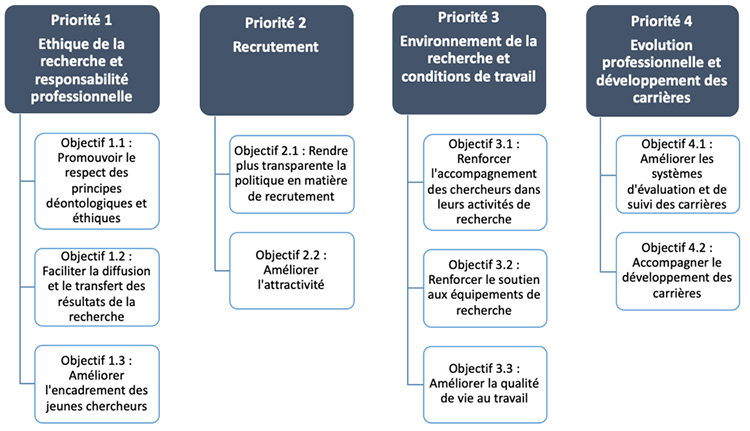
This action plan has been approved by the European Commission. The USMB now has 24 months to implement it before a mid-term evaluation. During this implementation phase, the USMB research community will be actively involved and will contribute ideas to create an increasingly supportive research environment for USMB researchers.