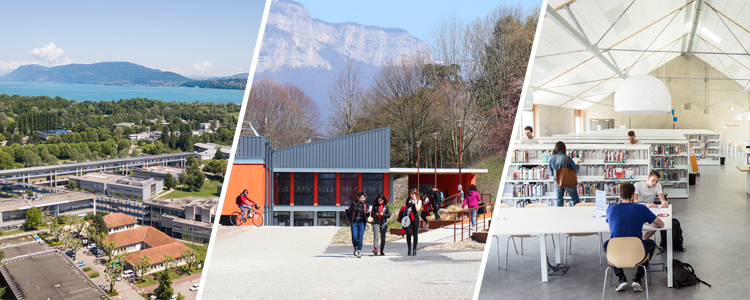


The University of Savoie Mont Blanc (USMB) is an institution that is deeply engaged with its immediate surroundings and actively involved in local and regional initiatives.
It enjoys the support of major public entities within its jurisdiction, which have demonstrated their confidence in the university: the French government, the Auvergne-Rhône-Alpes region, the departments of Savoie and Haute-Savoie, and the metropolitan areasof Annecy and Chambéry. It maintains close, constructive relationships with the municipalities where it is located and the CROUS regarding student life and the dissemination of knowledge, as well as with many other local stakeholders.
The university’s longstanding ties with local businesses are reflected in its close collaboration with several key partners:
- The USMB Business Club, an association founded in 1991 that works with the university to prepare students for the workforce and help graduates enter the job market;
- The USMB Foundation, which has been supporting research and innovation since 2016 through research chairs and exploratory projects addressing regional challenges;
- The Formasup Savoie Mont Blanc, Tétras, and ITII partnership-based vocational training centers in the two Savoie departments.
The USMB has 11 joint research units among its 18 laboratories and maintains excellent relationships with major research organizations (CNRS, INRAe, CEA, CERN). It is involved in several competitiveness clusters. It is a founding member of the National Institute for Solar Energy (INES) and a partner of the Institute for Energy Transition (ITE) INES-2S.
In the area of international relations, USMB is a member of the Network for Exchange and Cooperation among Francophone Higher Education Institutions (RELIEF), which will soon celebrate its 10th anniversary. It maintains targeted and active partnerships with 400 universities in 60 countries to facilitate student and staff mobility.
Finally, the USMB is a founding member of the European UNITA alliance, which includes 10 partners from 5 countries (Portugal, Spain, France, Italy, and Romania) and two associate partners in Switzerland and Ukraine. All of these institutions are located in mountainous and border regions. All use a Romance language. These shared characteristics give rise to common challenges. This makes it all the easier to define the alliance’s objectives and work together.