
Nearly 80 sandwich courses are offered to some 1,750 students, including 1,650 apprentices, atuniversité Savoie Mont Blanc. These courses cover a range of diploma levels (from BAC+3 to BAC+5).
Work-study programs combine a theoretical learning phase in an academics structure with a practical learning phase in a company. There are two types of contract for work-study academics :
Which audiences?
Young people between the ages of 16 and 29;Certain groups may enter apprenticeship after the age of 29, in particular those who have been recognized as disabled workers (RQTH).
Which employers?
Companies in the craft, commercial, industrial and agricultural sectors, as well as employers in associations and the liberal professions;Employers in the non-industrial and commercial public sector (state, regional and hospital civil services, as well as public administrative establishments).
The apprentice:
They receive training with the aim of obtaining a diploma or accredited qualification, and gain significant initial professional experience. They are subject to the same rules and enjoy the same benefits as all employees. Their remuneration is calculated as a percentage of the minimum wage (SMIC) or the minimum collective agreement (certain branch agreements or collective bargaining agreements provide for higher remuneration).
Employer:
He is responsible for ensuring the apprentice's professional academics . The company assigns the apprentice to activities defined by the school's educational manager and the apprentice's supervisor, in line with the trade and the diploma being prepared. The salary paid to the apprentice is totally or partially exempt from employer contributions.
Which audiences?
Young people aged 16 to 25
Jobseekers aged 26 and over
Certain specific groups can benefit from the professionalization contract
Which employers?
Any employer liable for financing continuing professional academics . The State, local authorities and their public administrative establishments may not enter into professionalization contracts.
The alternating :
The alternant is subject to the same rules and benefits as all employees. Their remuneration is calculated as a percentage of the minimum wage (SMIC) or the minimum collective agreement (certain branch agreements provide for higher remuneration). The cost of academics is borne by the company.
Employer:
He or she is responsible for ensuring the work-study student's professional academics within the company. A tutor is appointed to welcome and guide the work-study student in the company. He or she will entrust the work-study student with activities that are consistent with the target job and the diploma being prepared.
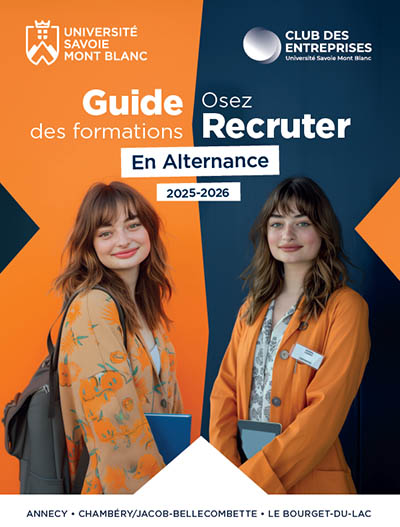
Our work-study programs 2024-2025
A wide range of fields
Business, Purchasing, Marketing, Digital marketing,
Communication, International, Tourism
Administration, Accounting, Payroll, Management, Law,
Human Resources
Digital creation, Multimedia, Design,
Culture, Events
Surveys, Studies, Social sciences
Insurance, Banking, Finance, Real Estate
Civil Engineering, Building, Public Works, Construction
Physics, Electronics, Computing, Robotics,
Database, Networks, Automation, Telecommunications
Download the USMB 2024-2025 work-study catalog
The benefits of work-study
For work-study students :
- Combining theory and practice in the workplace
- Obtain a diploma recognized by companies
- Acquire skills before joining a company
- Finding a job quickly
- Get paid during your academics
- Be more competitive on the job market
For the employer :
- Quality candidates, carefully selected byUniversité Savoie Mont Blanc
- Secure the services of a motivated, committed employee over the long term, and benefit from financial assistance to cover his or her remuneration
- Benefit from the knowledge and skills of the work-study student to reflect on and take a step back from his or her practices.
- Benefit from studies and projects supervised byUniversité Savoie Mont Blanc , with access to tools and methods
- Meeting skills renewal needs
- To be able to more effectively recruit a potential future employee, already involved in the company's life and trained in its techniques.
- Use pooled funds from the Opérateur de Compétences (OPCO) to which it belongs to cover all or part of academics costs.
Contact
Are you a company looking for a work-study student?
Mail: club.entreprises@univ-smb.fr
Tel: +33 (0)4 50 09 24 82
Are you a student looking for an academics work-study program?
Contact SUIOIP (Service Commun Universitaire d'Information, d'Orientation et d'Insertion Professionnelle)
Mail: service.orientation@univ-smb.fr
Tel : +33 (0)4 79 75 94 83