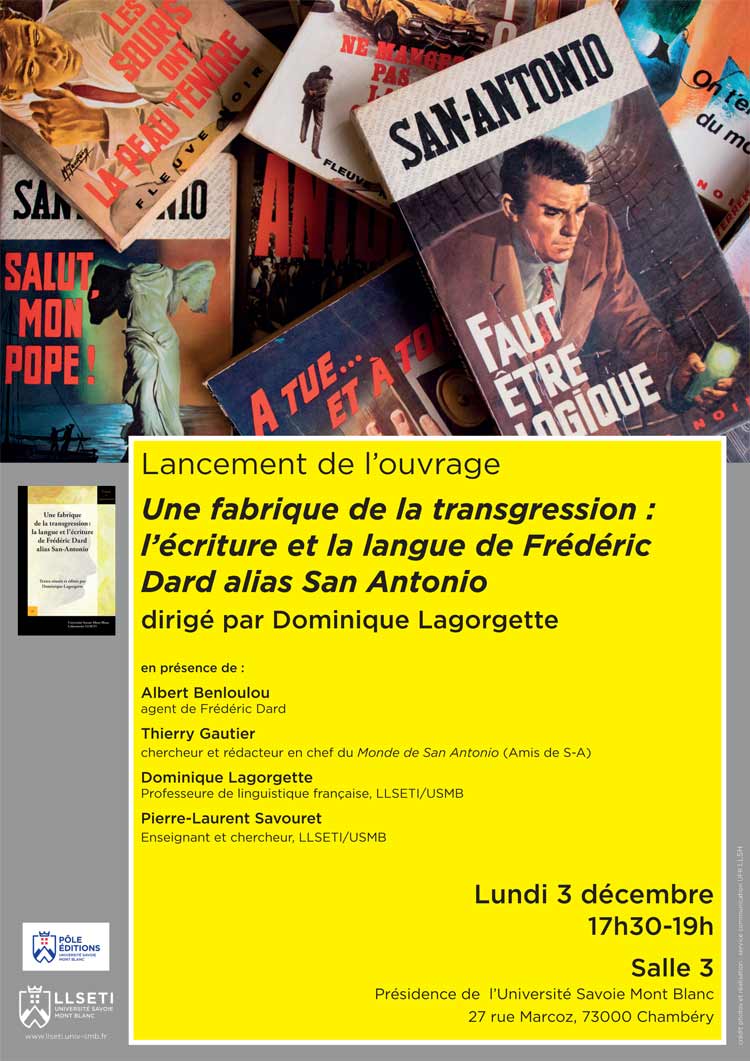
On Monday, December 3, at the Presidency of the University of Savoie Mont Blanc (USMB), there will be a launch of the book Une Fabrique de la transgression: la langue et l’écriture de Frédéric Dard alias San-Antonio (A Factory of Transgression: The Language and Writing of Frédéric Dard, alias San-Antonio), edited by Dominique Lagorgette, Professor of French Linguistics and researcher at the Langages, Literature, Societies, Cross-Border and International Studies (LLSETI), published by the University of Savoie Mont Blanc.
The launch will take place in Room 3, from 5:30 p.m. to 7 p.m., in the presence of:
- Albert Benloulou, agent of Frédéric Dard
- Thierry Gautier, researcher and editor-in-chief of Le Monde de San-Antonio (Friends of S-A)
- Dominique Lagorgette, Professor of French Linguistics, LLSETI / USMB
- Pierre-Laurent Savouret, professor and researcher, LLSETI/USMB
Dominique Lagorgette is a specialist in transgressive discourse and edited this collective work, which brings together 17 studies on Frédéric Dard's entire crime and noir oeuvre. Pierre-Laurent Savouret, a specialist in crime fiction, studied La Peuchère, Frédéric Dard's first novel, in particular. Thierry Gautier, who has been working on San-Antonio for decades, is editor-in-chief of Le Monde de San-Antonio, the magazine of the Friends of San-Antonio society. Albert Benloulou was Frédéric Dard's agent, among other things.
about the book
For anyone interested in 20th-century popular literature, it is now unthinkable not to examine the work of Frédéric Dard, whether it be his San-Antonio series or his lesser-known (because very different in content and form) noir novels published under his own name. This volume, the result of two symposiums in Chambéry on transgression and on the language and writing of F. Dard, shows the complexity of this author's relationship with literature, renewing the codes of the detective novel and noir fiction by transgressing them while establishing his own practice. It paints a picture of a multifaceted body of work whose coherence cannot be overlooked, even if the style sometimes gives the illusion of great diversity. From La Peuchère to his latest novels, it is clearly the same voice, sometimes cheerful and playful, sometimes dark and tragic, that explores the themes of evil, fear, death, and the sacred. In addition to the thirteen chapters dealing with these questions of substance and form, there are two interviews with his close friends (Albert Benloulou, Françoise Dard) and an interview with Frédéric Dard.
learn more
Free admission.Contact: Dominique Lagorgette