The Languages, Literatures, Societies, Transborder and International Studies Laboratory (LLSETI) at the University of Savoie Mont Blanc is organizing a seminar titled “Text, Image, and Digital Arts” on the theme “In Search of the Glorious Body: Transhumanist Worlds and Posthumanist Issues in Black Mirror.” The seminar will feature Sara Touiza-Ambroggiani, PhD in Philosophy, affiliated with the Laboratory for Studies and Research on Contemporary Philosophical Logics(LLCP) at Paris 8 University.
The seminar will be held on Friday, March 6, 2020, from 2:00 p.m. to 4:00 p.m. in Lecture Hall 11 000 in Building 10 on the Jacob-Bellecombette campus.
About the seminar
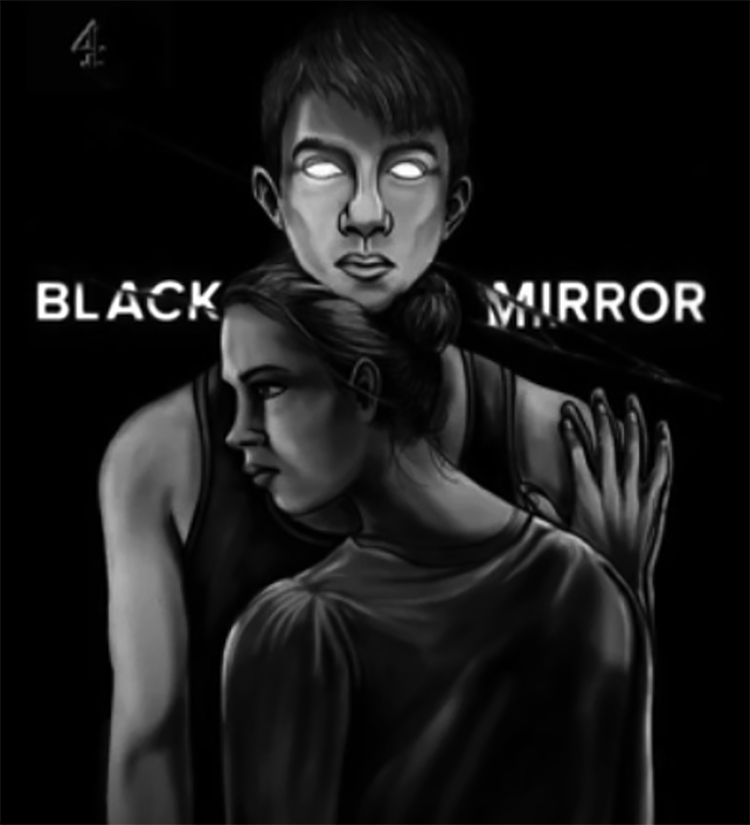
Black Mirror, the anthology series created by Charlie Brooker, explores, episode by episode, the ambiguity that characterizes our relationship with today’s rapid technological advances. Both fascinated and frightened by the devices they use every day, Black Mirror viewers find themselves confronted with their own contradictions. The first of these is witnessing, in front of a screen, the dramatization of their own screen addiction. Many scenes across the various episodes play on this mise en abyme. The latest installment, Bandersnatch, takes the mirror effect to its peak by making the Netflix streaming platform one of the characters in the interactive film.
The worlds depicted in the various episodes evoke a sense of unsettling familiarity, and the reflective loops that unfold within them offer a glimpse of the inevitability of humanity’s technological hybridization alongside its moral decline. The body plays a central role in this downfall. The body is both “the tomb of the soul” in the Platonic sense and the vehicle for a hoped-for redemption. The connected bodies we encounter in the Black Mirror universe all seek to augment human capabilities (enhancing perception, memory, and emotions) through technological artifacts. Here we see a straightforward portrayal of the transhumanist ideal.
However—and this is where the philosophical interest of this series lies—augmentation constantly runs up against issues related to personal identity, to the sense of being oneself. It is as if this sense could not be satisfied by an expanded consciousness alone, but drew its lifeblood from the very depths of a human body, one that is simply corruptible. The worlds depicted in the series are clearly transhumanist, but the problematic issues revealed are distinctly posthumanist in the sense that the characters experience—in their very flesh—the very possibility of a renewed conception of subjectivity, no longer considered as “interiority,” but as a space of constant negotiation between different beings, a space distributed across multiple poles (natural/artificial, organic/mechanical). Even when consciousnesses manage to free themselves from bodies, as in San Junipero or White Christmas, the body is not “erased”; it is always replaced by a digital body, a fantasized body, a glorious body in the sense of Christian mysticism.
The characteristics of the glorious body are those of these projections of the body: impassivity, clarity, agility, and subtlety. But the fleshly body still resists being replaced; it persists despite relentless efforts to transcend it. A second line of inquiry then opens up: the body is both what we seek to overcome, transcend, and erase, yet it is also what resists technological hubris, what derails the attempt at total control over human destinies. Fleshly bodies resemble glitches in the fluid universe of ethereal digital consciousnesses; they constantly thwart the fantasy of their total transcendence.
Drawing on an analysis of a few selected episodes, we propose to explore the fate of physical bodies in the face of digital bodies in the series *Black Mirror*.
Learn more
- Free admission and open to all
- Contact: Anais Guilet