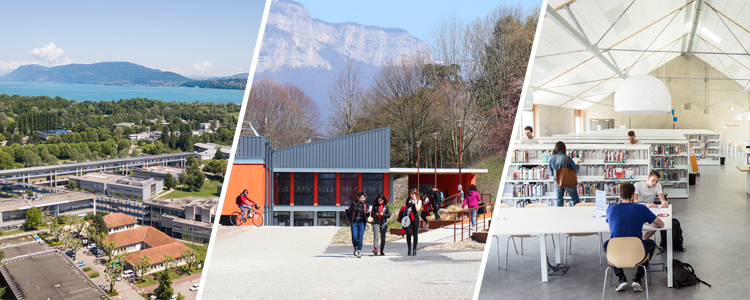
The University of Savoie Mont Blanc (USMB) andthe Institute of Earth Sciences (ISTerre) are participating in the CRYO-ADAPT project, a Franco-Swiss cross-border initiative that aims to better understand the interactions between permafrost and mountain infrastructure in order to help local stakeholders anticipate the effects of climate change and adapt their structures in a sustainable manner.
The Project at a Glance
The CRYO-ADAPT project aims to improve the characterization of interactions between permafrost and mountain infrastructure, as well as the evolution of permafrost in these areas of interaction. To this end, it draws on cross-analyses and the integration of complementary expertise gathered at shared study sites.
The project focuses specifically on highly fractured rock formations, which are found beneath the majority of infrastructure in the Interreg France-Switzerland cooperation area. The knowledge generated—which geotechnical engineers can apply directly—will help engineering firms and infrastructure managers better understand and anticipate how these structures will evolve in the context of climate change.
The goal is to provide stakeholders in mountain regions with knowledge, methodological tools, and decision-support resources to develop more sustainable and resilient management practices. These proactive measures may include predictive maintenance, structural reinforcement, modifications to foundation systems, appropriate monitoring instrumentation, and active systems for thermal stabilization of permafrost.
Two complementary areas of action
- Improving the characterization of infrastructure-supporting soils: The project will develop and implement three-dimensional—and even four-dimensional, through temporal monitoring—thermal and mechanical characterization of infrastructure-supporting soils in highly fractured rock environments. To this end, non-intrusive, non-destructive, cost-effective, and environmentally friendly methods will be tested to map the spatial distribution of permafrost based on thermal and geophysical measurements, supplemented by monitoring ground deformation over time.
- Ensure operational transfer to geotechnical engineering: In addition to field observations, the project will develop a multiscale, multiphysical model of soil behavior to calculate and predict the mechanical evolution of soils and infrastructure under various climate scenarios and hydrological conditions. This work will make it possible to propose tools for interfacing between geotechnical science and engineering, as well as methods that professionals can directly apply.
Partners
This project is being implemented by a cross-border consortium comprising the following partners:
- On the French side: Géolithe Innov (lead partner), NAGA Geophysics, SAGE Ingénierie, the University of Savoie Mont Blanc, andthe Institute of Earth Sciences (ISTerre);
- On the Swiss side: HEIG-VD, the University of Lausanne, HES-SO Valais-Wallis, and the Société simple du Mont Fort (self-funded).

Calendar
The CRYO-ADAPT project will run from March1, 2026, to July 31, 2028.
Financial Support
The CRYO-ADAPT project is supported by the Interreg France-Switzerland 2021–2027 European Territorial Cooperation Program under project ID 21709 and, as such, receives funding from the European Regional Development Fund (ERDF), Swiss Interreg federal funds, and cantonal funds.
- Total project budget: €1,481,765, or CHF 1,307,277
- USMB Budget: €201,676
- Planned ERDF funding: €611 ,829
- Amount of federal funding: 170,000 CHF
- Amount of cantonal funds: 130,000 CHF
Learn more
- Visit the Interreg France-Switzerland program website
- Visit the CRYO-ADAPT project page on the Interreg France-Switzerland program website
- Contact at USMB: François Nicot, faculty member and researcher at ISTerre