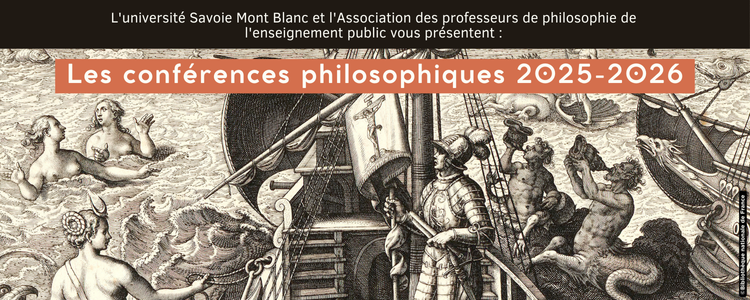
Organized by the Languages, Literatures, Societies, Transborder and International Studies (LLSETI) at USMB and the Association of Public School Philosophy Teachers, the 2025–2026 series of philosophy lectures, titled “Imagination, the Imaginary, and the Image,” continues this Wednesday, April 29, 2026, at 5:00 p.m. with the theme: “From Architectural Utopias to Utopian Architectures.” This lecture will take place in Room 3 at the University of Savoie Mont Blanc (USMB) administration building in Chambéry. It is open to the public and does not require registration.
About the conference
How has the intrinsic link between utopia as a literary genre and the discipline of architecture been able to inspire a number of actual architectural projects, whether at the building or urban scale? Indeed, while utopia as a literary genre proposes a social model, this model cannot exist without a spatial one. Nevertheless, the status of this model is to remain within the realm of the possible: it is a regulatory horizon that does not claim to be a blueprint to be realized as is. Yet the very nature of the architectural project is to move from the possible to the real, to materialize a certain intention by inscribing it here and now. How have architects and urban planners appropriated the spatial dimension of literary utopias to elevate it from the status of a model to that of a plan, thereby blurring the line between the real and the ideal—or at least transposing one into the other without translating it, while accounting for its temporal modality? What in architectural utopias allowed for this transition? How do utopian architectures sometimes tip over into dystopia?
This lecture will be led by Céline Bonicco-Donato, a professor at the École Nationale Supérieure d’Architecture de Grenoble, part of the Université Grenoble Alpes.
About the annual cycle "Imagination, the Imaginary, and Image."
To imagine is to bring absent realities into the present. Myths and religions have used this method, and the arts and sciences use it to understand, scrutinize, and also criticize, in order to protect themselves, if necessary, from the vertigo of madness. Because of this assumption of the unknown into which we plunge to find something new again and again, our imaginations, our imaginations, our images, can lead us just as easily to nightmares as to new dawns. This is what we must imagine in order to move towards the better, progress towards the beautiful, hope for the just, against the fear that subjugates us to what is or to false dystopian hopes.
LEARN MORE
- Program for the 2025-2026 philosophy lecture series
- LLSETI laboratory website
- Contact: Pascal Bouvier, member of the LLSETI laboratory and organizer of this conference series