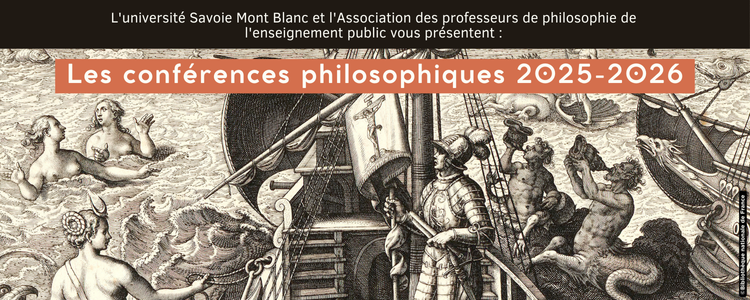
Organized by the Languages, Literatures, Societies, Transborder and International Studies (LLSETI) at the University of Savoie Mont Blanc (USMB) and the Association of Philosophy Teachers in Public Education, the 2025-2026 series of philosophy lectures, entitled "Imagination, the Imaginary, and Image," continues on Wednesday, January 28, 2026, at 5 p.m. with the theme: "The Crisis of the Modern Political Imagination." This lecture will take place in Room 3, at the presidency of the University of Savoie Mont Blanc (USMB), in Chambéry. It is open to all and no registration is required.
About the conference
The modern political imagination took shape in the 17th century based on the new representation of nature introduced by the "Copernican revolution." Nature then ceased to speak to human societies, prompting Pascal's libertine to say, "the eternal silence of infinite space frightens me." Two forms of political construction emerged from this new imagination: contractualism and historicism. These representations are similarly exposed to the crises of the modern political imagination. The first is a crisis of legitimacy because this imagination was formed in connection with positions of domination, mainly ethnic, cultural, and sexual, with some adding speciesism. The second is a crisis of resources, which stems from the generalization of utilitarianism and positivism, which we have already discussed several times. In other words, the crisis of resources comes from the commodification and bureaucratization of social reality, which stunts the imagination. The third crisis is one that is coming, and it would be presumptuous to talk about it several weeks in advance, but we can call it a crisis of acceleration. We do not know where an accident might come from, but we see that it can happen anywhere and at any time, and that we are morally helpless.
This lecture will be led byMichel Haudry, Professor of Economics and Social Sciences at Louis Armand High School, Chambéry.
About the annual cycle "Imagination, the Imaginary, and Image."
To imagine is to bring absent realities into the present. Myths and religions have used this method, and the arts and sciences use it to understand, scrutinize, and also criticize, in order to protect themselves, if necessary, from the vertigo of madness. Because of this assumption of the unknown into which we plunge to find something new again and again, our imaginations, our imaginations, our images, can lead us just as easily to nightmares as to new dawns. This is what we must imagine in order to move towards the better, progress towards the beautiful, hope for the just, against the fear that subjugates us to what is or to false dystopian hopes.
LEARN MORE
- Program for the 2025-2026 philosophy lecture series
- LLSETI laboratory website
- Contact: Pascal Bouvier, member of the LLSETI laboratory and organizer of this conference series