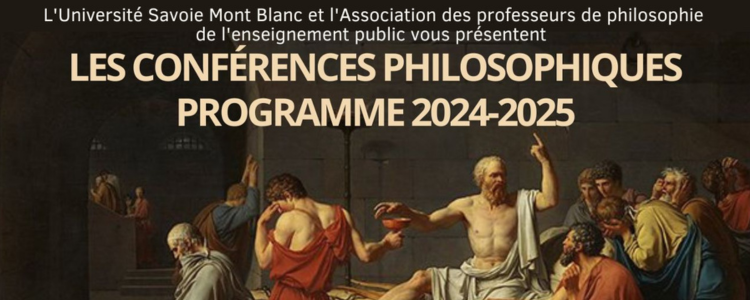
Organized by the Languages, Literatures, Societies, Transborder and International Studies (LLSETI) at USMB and the Association of Philosophy Teachers in Public Education, the series of philosophical lectures "Towards an Ethics of Discussion, Democratic Issues" continues this Wednesday, February 19, at 5 p.m. with the theme "Judgment of Taste and its Sociological Issues." This lecture will take place in Room 3, at the presidency of the University of Savoie Mont Blanc (USMB), in Chambéry. It is open to all and no registration is required.
About the conference
The expansion of the faculty of judgment is the horizon of meaning for modern democracy, which posits that this faculty is accessible to all. Can the "bourgeois public sphere" that emerged in the 18th century as the public ofthe Enlightenment be expanded to include everyone? It is legitimate to doubt this, given that what we now call public opinion seems to be rather unenlightened. Is it conceivable, however, to make "common sense" a healthy sense (gesunde Verstand) rather than a vulgar sense, and to envisage on this basis the joint development of intelligibility (eines gemeinschaftlichen Sinnes)? Does the broadening of taste judgment allow opinion to move towards enlightenment? The social critique of judgment, developed by Pierre Bourdieu in the 1970s, renews, from a sociological perspective, the ancient distinction made by intelligence between what it perceives and what is generally not perceived. But if taste judgment were conducive to what Kant calls an expanded mentality, would it not then have political virtues?
This lecture will be led by Michel Haudry, Professor of Economics and Social Sciences at Lycée Louis Armand in Chambéry.
About the series "Towards an Ethics of Discussion: Democratic Issues"
We seem to have become powerless in the face of the widespread disruption of discussion, which we too readily attribute to effectively deregulated media outlets. We must never forget that our societies are still plagued by emotions that incite violence, the very ones Freud warned us about in Civilization and Its Discontents. At the same time, this disruption of discussion into irreconcilable battles, into "agonistics," clearly undermines democratic debate. And the remedies for this cannot be based on the invocation of reason, or even of truth, which remain powerless in political debate. Even if it is necessary to defend facts and use reason against conspiracy theories and negativism, democratic discussion is not based on the authority of truths but on the pluralism of opinions, without which it could not exist and which must be defended. There is no doubt that we must promote a culture of democratic conflict and its normal functioning. We will seek to develop this hypothesis by considering it through a number of fields that embody its expression.
LEARN MORE
- Program for the 2024-2025 series of philosophy lectures
- LLSETI laboratory website
- Contact: Pascal Bouvier, member of the LLSETI laboratory and organizer of this conference series