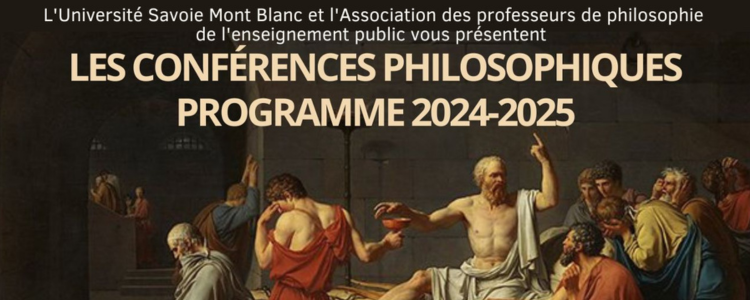
Organized by the Languages, Literatures, Societies, Transborder and International Studies (LLSETI) at USMB and the Association of Public School Philosophy Teachers, the series of philosophical lectures “Toward an Ethics of Discussion: Democratic Issues” continues this Wednesday, April 16, at 5:00 p.m. with the theme “Public Spaces: Spaces for Debate or Spaces Under Debate? ." This lecture will take place in Room 3 at the University of Savoie Mont Blanc (USMB) administration building in Chambéry. It is open to all and requires no registration.
About the conference
While Jürgen Habermas and Hannah Arendt view the public sphere as an essentially democratic space, neither of them pays much attention to its physical qualities. Yet the public sphere is not merely a space for rational discussion and collective action; it is first and foremost a network of streets, squares, media libraries, gymnasiums, and other public facilities. How should these places be designed to facilitate the emergence of communities? Does the democratic character of these places stem solely from the verbal discussions that may take place there and the exchange of arguments, or is it also linked to the non-verbal dialogue between the bodies of users? In this presentation, we propose to explore the relationship between the symbolic dimension of public space and the material dimension of public places, in order to understand certain challenges in the evolution of their design. How do they—or do they not—foster the creation of a space for debate?
This lecture will be led by Céline Bonicco-Donato, Professor at the École Nationale Supérieure d’Architecture de Grenoble (ENSG) at the University of Grenoble Alpes.
About the series "Towards an Ethics of Discussion: Democratic Issues"
We seem to have become powerless in the face of the widespread disruption of discussion, which we too readily attribute to effectively deregulated media outlets. We must never forget that our societies are still plagued by emotions that incite violence, the very ones Freud warned us about in Civilization and Its Discontents. At the same time, this disruption of discussion into irreconcilable battles, into "agonistics," clearly undermines democratic debate. And the remedies for this cannot be based on the invocation of reason, or even of truth, which remain powerless in political debate. Even if it is necessary to defend facts and use reason against conspiracy theories and negativism, democratic discussion is not based on the authority of truths but on the pluralism of opinions, without which it could not exist and which must be defended. There is no doubt that we must promote a culture of democratic conflict and its normal functioning. We will seek to develop this hypothesis by considering it through a number of fields that embody its expression.
LEARN MORE
- Program for the 2024-2025 series of philosophy lectures
- LLSETI laboratory website
- Contact: Pascal Bouvier, member of the LLSETI laboratory and organizer of this conference series