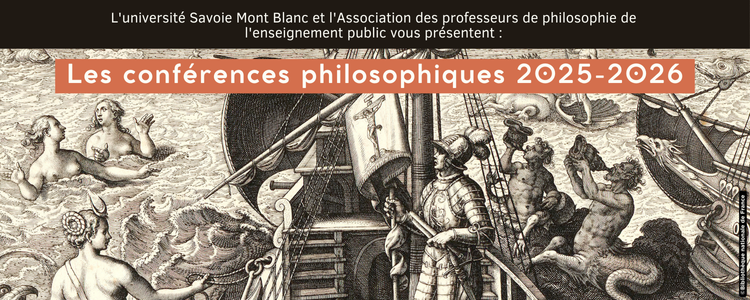
Organized by the Languages, Literatures, Societies, Transborder and International Studies (LLSETI) at USMB and the Association of Public School Philosophy Teachers, the 2025–2026 series of philosophy lectures, titled “Imagination, the Imaginary, the Image,” continues this Wednesday, March 18, 2026, at 5:00 p.m. with the theme: “What imaginaries does current economic thought propose?” This lecture will take place in Room 3 at the University of Savoie Mont Blanc (USMB) administration building in Chambéry. It is open to all and requires no registration.
About the conference
Economic thought today is largely confined to a narrative centered on growth. The prevailing narrative holds that we have a natural, anthropological inclination toward commercial exchange, innovation, and reason. Setting ourselves apart from the wild, we are “Humans,” and our measure of progress and development is growth. In this context, how could economic thought foster new narratives? Economic thought does not stop at the dominant narrative—far from it—nor does it stop at economism. To understand how economics can foster new narratives, we must focus on rethinking its place, its axioms, its hypotheses, and its models. In a world undergoing profound transformation, the challenge is to envision the futures of tomorrow without locking ourselves into a single narrative. The retreat of globalization and the geopolitics of resources clearly show us that our systems are not immutable, and must also lead us to consider alternatives to the system, for history is far from over. So what visions does current economic thought offer?
This lecture will be led by Alexandra Raedecker, Associate Professor of Social Sciences at INP Grenoble.
About the annual cycle "Imagination, the Imaginary, and Image."
To imagine is to bring absent realities into the present. Myths and religions have used this method, and the arts and sciences use it to understand, scrutinize, and also criticize, in order to protect themselves, if necessary, from the vertigo of madness. Because of this assumption of the unknown into which we plunge to find something new again and again, our imaginations, our imaginations, our images, can lead us just as easily to nightmares as to new dawns. This is what we must imagine in order to move towards the better, progress towards the beautiful, hope for the just, against the fear that subjugates us to what is or to false dystopian hopes.
LEARN MORE
- Program for the 2025-2026 philosophy lecture series
- LLSETI laboratory website
- Contact: Pascal Bouvier, member of the LLSETI laboratory and organizer of this conference series