
October 2–12, 2026: Come meet the researchers at USMB!
In 2026, the Fête de la Science invites you to explore the theme “Savory Science” and the close connections between science, cooking, taste, and food.
On the agenda
IN SAVOY MEET THE RESEARCHERS AT USMB
Tuesday, October 6 • Lecture • 6:00 p.m. to 7:30 p.m. • USMB Presidency, Chambéry
Amphis for Everyone – Do Food Apps on Our Smartphones Influence Us?
By Caroline Morrongiello, lecturer and researcher at the Institute for Research in Management and Economics (IREGE)
Apps like Yuka offer to evaluate the quality of food based on nutritional information and the presence of additives, often using color-coded ratings and sometimes an overall score. How do consumers use this information to judge whether a product is healthy or not? Recent findings show that nutrients are generally evaluated in a compensatory manner—that is, a negative aspect can be offset by a positive one. In contrast, when it comes to additives, a single negative signal is often enough to significantly lower the product’s overall rating. So, do these tools really help us make better food choices? And to what extent do they influence—or even alter—our judgments?
Thursday, October 8 • Science Café • 12:30 p.m. to 1:30 p.m. • Eurêka, Chambéry
Between Lunch & Science – “Food: Just Another Addiction?”
By Arnaud Carré, lecturer and researcher at the Interuniversity Laboratory of Psychology / Personality, Cognition, and Social Change (LIP/PC2S)
Emotional eating and food addiction—two relatively recent concepts in mental health—raise questions about the complexity of our relationship with food. While these are not new disorders, these two concepts offer a fresh perspective on eating disorders and open up innovative avenues for diagnosis. So, should eating be viewed as an addiction, like alcohol and drugs?
Saturday, October 10, and Sunday, October 11 • Village des Sciences • From 10:00 a.m. to 12:30 p.m. and from 2:00 p.m. to 6:00 p.m. • Eurêka, Chambéry
Booth: “Do Microwaves Have a Taste?”
By Pietro Maris Ferreira, professor and researcher at the Center for Radiofrequencies, Optics, and Micro-Nanoelectronics of the Alps (CROMA)
The CROMA laboratory presents its scientific models for exploring wave physics. By connecting fundamental physics, food, health, and everyday practices, this activity demonstrates that behind every flavor lie invisible yet crucial scientific phenomena, and that wave physics is a key tool for understanding and improving our relationship with food.
Exhibition Booth: “Earth Sciences: A Rich History”
By Blandine Gardonio, CNRS research fellow at the Institute of Earth Sciences (ISTerre)
Can we predict earthquakes? Why and where do they occur? What impact do they have on homes? What types of volcanic eruptions can we predict? Do you know how many volcanoes there are on Earth’s surface? How do folds and faults form? These are all questions that guide our research and that we’ll be exploring during the Science Festival. Come one, come all to experience earthquakes, build folds, and record your own vibrations.
Booth: “Fun with Math—Let’s Discover Through Hands-On Activities”
By Valentin Gledel, lecturer and researcher at the Mathematics Laboratory (LAMA)
Come learn the basics of mathematical proofs and discover machine learning through interactive math puzzles and a very simple game.
Booth: “Discover Physics Through Fun Activities”
By Maud Coppel, Communications Officer at the Annecy Laboratory of Particle Physics (LAPP)
The Annecy Particle Physics Laboratory invites you to explore the world of physics through science games.
Booth: “FoVEquiPeut: Experience Fatigue Through an Animal’s Eyes!”
By Maximilien Bowen, Ph.D. candidate at the Interuniversity Laboratory of Motor Biology (LIBM)
Step into the shoes of a wild animal with our bio-connected arcade machine! To escape your predator or catch your prey, being smart won’t be enough—you’ll have to physically press a sensor or pedal to move. Will you be able to manage your fatigue before you get caught? A unique experience combining video games, ecology, sports, and science!
Exhibition Booth “The Signals Around Us”
By Argheesh Bhanot, faculty member and researcher at the Laboratory of Computer Science, Systems, Information Processing, and Knowledge (LISTIC)
Gain a better understanding of the signals around us through a step-by-step journey to discover what a signal is, why it needs to be processed, and how we can make invisible phenomena visible.
Booth: “Tell Me How You Eat, and I’ll Tell You How You Speak”
By Claudia D’Amelio and Marc-Philippe Brunet, a doctoral student and a faculty researcher at the Laboratory for Languages, Literatures, Societies, Transborder and International Studies (LLSETI)
Pain au chocolat or chocolatine? Do we all speak the same languages—the same French, the same English? Although we understand one another and share the same linguistic codes, researchers have observed differences—some more noticeable than others—in the ways speakers of the same language speak. What explains these differences? Is it a matter of choice? Do we attach the same value to these differences, and if not, why?
Booth: “The Celtic Banquet: A Tasting of Celtic Legends and Languages”
By Noémie Beck, lecturer and researcher at the Laboratory for Languages, Literatures, Societies, Cross-Border and International Studies (LLSETI)
Immerse yourself in *The Celtic Banquet* and let yourself be surprised by a unique experience blending flavors, languages, and legends. Through games, riddles, and stories, discover Celtic cultures in a whole new way. Young and old alike are invited to taste, listen, and participate. Can you recreate the banquet and uncover its secrets?
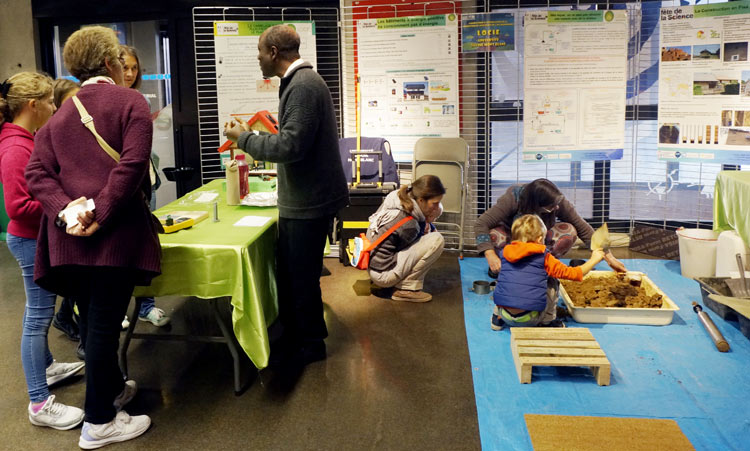
Exhibition Booth: “When Science Puts Things to the Test: Energy, Air, and Materials Shape Our Built Environment at the Heart of Sophisticated Flavors”
By Christophe Ménézo, professor and researcher at the Laboratory of Building Energy Processes (LOCIE)
The LOCIE laboratory invites you to visit its interactive exhibit focusing on energy, air quality, and experimental analysis of material deformation and stress. Through interactive experiments, accessible demonstrations, and posters, discover how energy flows, the environments in which we live, and the building materials around us represent significant environmental challenges and influence how we feel.
IN HAUTE-SAVOIE MEET THE RESEARCHERS AT USMB
Wednesday, September 23 • Lecture • 6:30 p.m. to 8:00 p.m. • MJC, Annemasse
Amphis for Everyone – Do Food Apps on Our Smartphones Influence Us?
By Caroline Morrongiello, lecturer and researcher at the Institute for Research in Management and Economics (IREGE)
Learn more about the conference “Do Food Apps on Our Smartphones Influence Us?”
Friday, September 25 • Lecture • 7:00 p.m. to 7:30 p.m. • Turbine Sciences, Annecy
Researchers' Night – The Body in Eating Disorders
By Morgane Metral, lecturer and researcher at the Interuniversity Laboratory of Psychology / Personality, Cognition, Social Change (LIP/PC2S)
A negative body image—or a distorted perception of one’s body—can lead some people to try to reshape their bodies in order to feel less dissatisfied with their weight and/or shape (through dieting, exercise, medication, etc.). When body hatred is too intense or one’s perception of the body is too distorted, the behaviors adopted to reshape the body can become pathological, even leading to eating disorders. These disorders can take various forms: anorexia nervosa, bulimia nervosa, and binge eating disorder.
Thursday, October 1 • Lecture • 7:00 p.m. to 8:30 p.m. • Ourse Bleue Media Library, Fillinges
Amphis for Everyone – Do Food Apps on Our Smartphones Influence Us?
By Caroline Morrongiello, lecturer and researcher at the Institute for Research in Management and Economics (IREGE)
Learn more about the conference “Do Food Apps on Our Smartphones Influence Us?”
Friday, October 2 • Lecture • 6:00 p.m. to 7:30 p.m. • Pôle culturel de la Visitation, Thonon-les-Bains
Amphis for Everyone – Do Food Apps on Our Smartphones Influence Us?
By Caroline Morrongiello, lecturer and researcher at the Institute for Research in Management and Economics (IREGE)
Learn more about the conference “Do Food Apps on Our Smartphones Influence Us?”
Saturday, October 3, and Sunday, October 4 • Village des Sciences • 10 a.m. to 12 p.m. and 2 p.m. to 6 p.m. • LAPP and LAPTh, Chemin de Bellevue, Annecy
Open House to Celebrate LAPP’s 50th Anniversary
By the researchers and faculty members of the Annecy Laboratory of Particle Physics (LAPP)
In 2026, the Annecy Particle Physics Laboratory will celebrate its 50th anniversary! Come celebrate this major event with the scientists in Annecy during a special open house. On the agenda: interactive workshops led by lab staff, tours of the EUTOPIA Discovery Center and the MUST computing and storage center, exhibitions, lectures, and planetarium shows in partnership with La Turbine Sciences.
Registration for activities is required via the LAPP website: https://indico.in2p3.fr/event/39766/
Exhibition booth “At the Physicists’ Table: When the Universe Is a Delicacy”
By researchers and faculty members at the Annecy Laboratory of Theoretical Physics (LAPTh)
Designed as a mini science amusement park, this exhibit features several interactive workshops that explore the mysteries of theoretical physics in a creative and accessible way. Through play, hands-on activities, experimentation, and simulation, visitors will be encouraged to ask questions, model problems, and experience scientific research firsthand. Ages 10 and up.
There will be several activities on offer over the weekend:
- Stacking dominoes
An introductory workshop on scientific modeling through a game of balance and problem-solving. From a simple stack to the mechanics of forces: how does physics explain why dominoes fall?
- The Black Box
Budding science detectives, can you guess what’s inside the black box? By conducting experiments and taking measurements, try to solve the mystery like real physicists!
- Tutti Quantum
A fun introduction to particle physics through a board game designed to explain some key concepts in the field. You don’t need any prior knowledge of physics to play! But before you know it, after just one game, you’ll know a little more about how elementary particles interact with each other to build the world around us.
- Q&A! A theoretical physicist answers your questions and explains what he does.
Exhibition Booth: “Mathematical Information Theory: The Origins of Digital Technology”
By Yassine Mhiri, faculty member and researcher at the Laboratory of Computer Science, Systems, Information Processing, and Knowledge (LISTIC)
How is digital information represented? How do we measure the amount of information? Pioneered by Claude Shannon in 1949, the mathematical theory of information answers these questions. It continues to govern our digital systems today, right down to advanced artificial intelligence systems. Come discover the fundamentals of this theory through offline games and activities.
Wednesday, October 7 • Village des Sciences • 2:00 p.m. to 6:00 p.m. • OSCAR, Rumilly
Exhibition Booth: “Mathematical Information Theory: The Origins of Digital Technology”
By Yassine Mhiri, faculty member and researcher at the Laboratory of Computer Science, Systems, Information Processing, and Knowledge (LISTIC)
How is digital information represented? How do we measure the amount of information? Pioneered by Claude Shannon in 1949, the mathematical theory of information answers these questions. It continues to govern our digital systems today, right down to advanced artificial intelligence systems. Come discover the fundamentals of this theory through offline games and activities.
Thursday, October 8 • Lecture • 6:30 p.m. to 8:00 p.m. • Turbine Cinema, Annecy
Amphis for Everyone – Do Food Apps on Our Smartphones Influence Us?
By Caroline Morrongiello, lecturer and researcher at the Institute for Research in Management and Economics (IREGE)
Learn more about the conference “Do Food Apps on Our Smartphones Influence Us?”
Saturday, October 10 • Outing • From 2:00 p.m. to 3:00 p.m., then from 3:00 p.m. to 4:00 p.m. • Faille du Vuache, Chemin de Saint Martin, Sillingy
Publication: “The Origins of the 1996 Epagny-Annecy Earthquake”
By Riccardo Vassallo, lecturer and researcher at the Institute of Earth Sciences (ISTerre)
Thirty years ago, Haute-Savoie was rocked by one of the strongest earthquakes ever recorded in the Western Alps. What causes these phenomena in our region? Have events of the same intensity—or even greater—occurred in the more distant past and could they therefore happen again? We explore these questions at the foot of the geological feature responsible for this earthquake: the Vuache Fault at La Balme de Sillingy.
The objectives of Science Day
Every year, the Science Festival offers an opportunity to discover, understand, experiment with, and discuss the relationship between science and society, explore the technologies of today and tomorrow, and bring science closer to the public. Through engaging activities that blend science and culture, the Fête de la Science helps people discover the extraordinary richness of scientific disciplines and highlights the major contributions science makes to society and its new challenges.
Researchers from the University of Savoie Mont Blanc share their work and engage with the public
For Savoie Mont Blanc University, the Festival of Science is an opportunity to raise awareness of its research areas and its role in society. Interacting with high school students also helps to engage young audiences and foster an interest in science in general, as well as in scientific studies and careers.
Every year, the university’s staff, faculty, and researchers enthusiastically dedicate themselves to sharing their passion for science with the general public.
Learn more
- Check out the full program for the Science Festival in the Auvergne-Rhône-Alpes region
- About the 2026 Science Festival
- Contact at Savoie Mont Blanc University: Science and Society Division